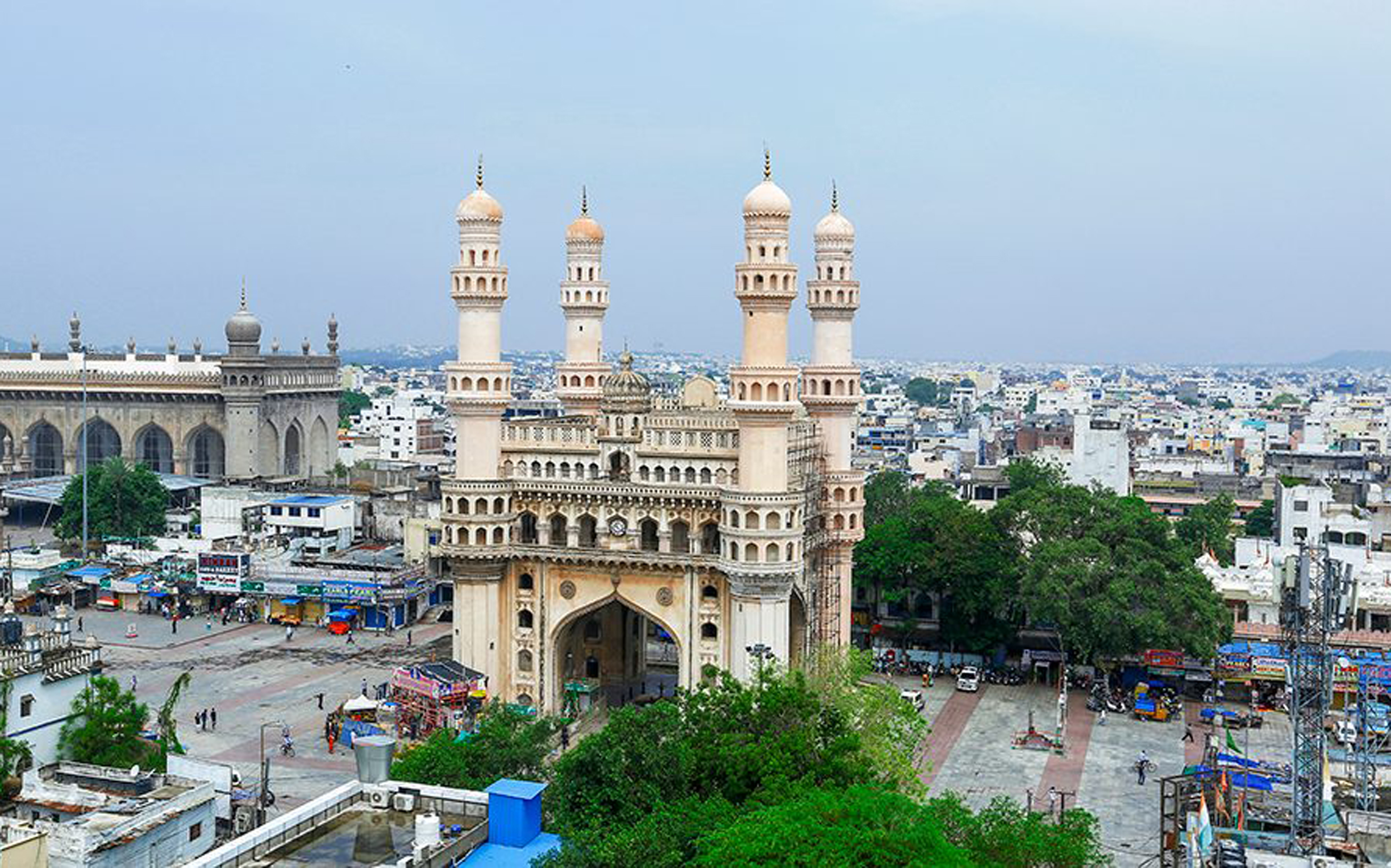
Charminar
📅 13 Feb 2026 | 👁 2 Views
The Charminar (lit. 'four minarets') is a monument located in Hyderabad, Telangana, India. Constructed in 1591, the landmark is a symbol of Hyderabad and officially incorporated in the emblem of Telangana.[3] The Charminar's long history includes the existence of a mosque on its top floor for more than 434 years. While both historically and religiously significant, it is also known for its popular and busy local markets surrounding the structure, and has become one of the most frequented tourist attractions in Hyderabad. Charminar is also a site of numerous festival celebrations, such as Eid-ul-adha and Eid al-Fitr,[4] as it is adjacent to the city's main mosque, the Makkah Masjid.
The Charminar is situated on the east bank of Musi River.[5] To the west lies the Laad Bazaar, and to the southwest the richly ornamented Makkah Masjid.[6] It is listed as an archaeological and architectural treasure on the official list of monuments prepared by the Archaeological Survey of India.[7] The English name is a translation and combination of the Urdu words chār and minar, translating to "Four Pillars"; the towers are ornate minarets attached and supported by four grand arches.[6]
History
The fifth ruler of the Qutb Shahi dynasty, Muhammad Quli Qutb Shah, built the Charminar in 1591 after shifting his capital from Golconda to the newly formed city of Hyderabad.
Charminar, Char Kaman and Gulzar Houz, photographed by Lala Deen Dayal in the 1880s
The Archaeological Survey of India (ASI), the current caretaker of the monument, mentions in its records, "There are various theories regarding the purpose for which Charminar was constructed. However, it is widely accepted that Charminar was built at the centre of the city, to commemorate the eradication of plague", a deadly disease which was widespread at that time.[8][9] According to Jean de Thévenot, a French traveller of the 17th century whose narration was complemented with the available Persian texts, the Charminar was constructed in the year 1591 CE, to commemorate the beginning of the second Islamic millennium year (1000 AH). The event was celebrated far and wide in the Islamic world, thus Qutb Shah founded the city of Hyderabad to celebrate the event and commemorate it with the construction of this building.[10][11]: 17–19
The construction began in 1589 and was completed in two years at a cost of Rs. 9 lakhs, which was around 2 lakh huns/gold coins in those times. Upon completion, it was the tallest structure in Hyderabad. It is said to weigh around 14000 tonnes with a minimum of 30 feet deep foundation. In 1670, a minaret had fallen after being struck by lightning. It was then repaired at a cost of around Rs. 58000. In 1820, some part of it was renovated by Sikandar Jah at a cost of Rs. 2 lakh.
The Charminar was constructed at the intersection of the historical trade route that connects the city to international markets through the port city of Machilipatnam.[12]: 195 The Old City of Hyderabad was designed with Charminar as its centrepiece.[13] The city was spread around the Charminar in four different quadrants and chambers, segregated according to the established settlements. Towards the north of Charminar is the Char Kaman, or four gateways, constructed in the cardinal direction.[10][12][14][15]: 170 Additional eminent architects from Persia were also invited to develop the city plan. The structure itself was intended to serve as a mosque and madrasa. It is of Indo-Islamic architecture style, incorporating Persian architectural elements. A sample of Charminar is said to have been created at Dabirpura/Nagaboli graveyard before the actual construction.